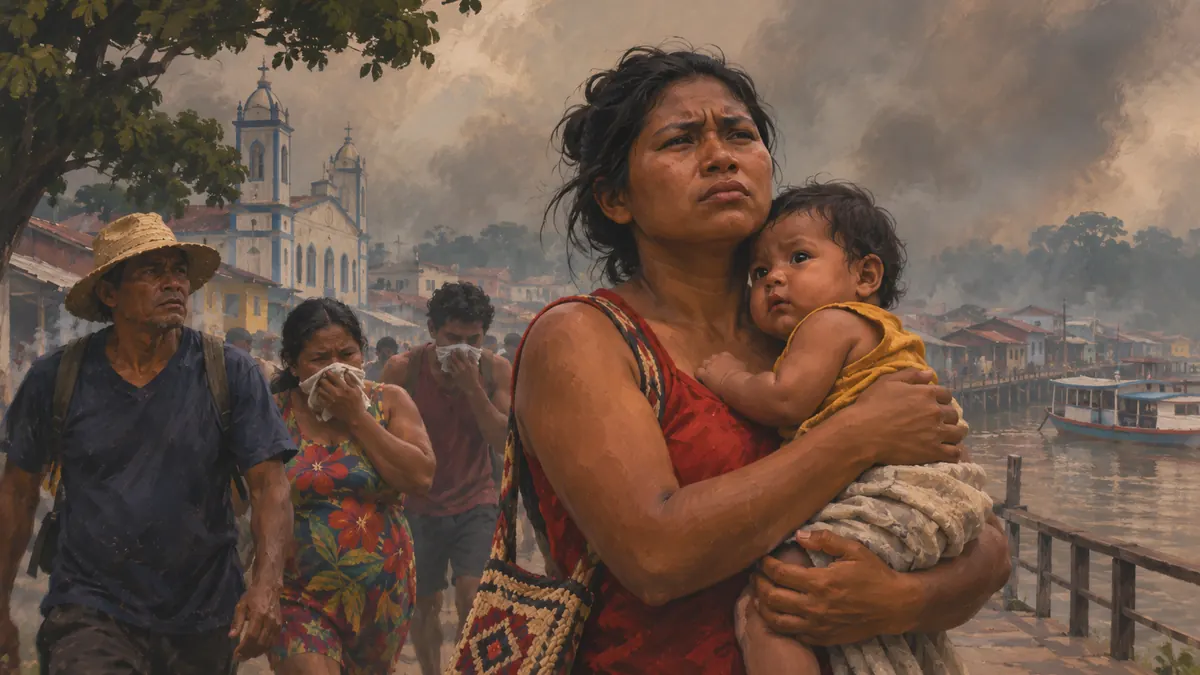
Smoke from fires left air quality in Parintins and six other municipalities in Brazil’s Amazonas state in the worst category on Sunday morning, according to monitoring data reported by G1. At 8 a.m. on November 22, particle concentrations reached 254.7 micrograms per cubic metre in Vila Amazônia, a district of Parintins, and 229.8 in the city centre.
Conditions had been more severe the previous night. The Qualiar-UFAM monitoring system recorded 1,520 micrograms per cubic metre in Parintins at 10 p.m. on November 21, more than ten times the threshold for its worst air-quality classification. Residents described the smoke as suffocating; one said it was preventing her baby from sleeping.
Sunday’s readings from the Amazonas State University’s Selva environmental surveillance system also placed Nhamundá, Barreirinha, Itapiranga, São Sebastião do Uatumã and Silves in the worst category. Three other municipalities—Itacoatiara, Urucará and Maués—were classified as having very poor air quality. Selva considers particle concentrations of up to 25 micrograms per cubic metre good.
Parintins was among 54 Amazonas municipalities under a drought emergency, while São Sebastião do Uatumã was on alert. State civil defence figures cited by the permanent committee dealing with climatic and environmental events put the number of families affected by drought at 169,733. The report did not say when the smoke would clear or how long the drought emergency would last.